Alert component for urgent information lorem ipsum dolor cet amin. magnam quas? Class quibusdam maxime, pulvinar hymenaeos ullamco, vehicula provident! Praesentium Can include linked text if needed.
Headline Goes Here and Here Lorem Ipsum Dolor Sit Amet Consectetur
laoreet massa adipiscing pulvinar. sed turpis Nulla rhoncus pharetra sapien dolore porta enim justo.
TAKE ACTION!With High-Quality Care, Our Harbor Seals are Outliving Expectations

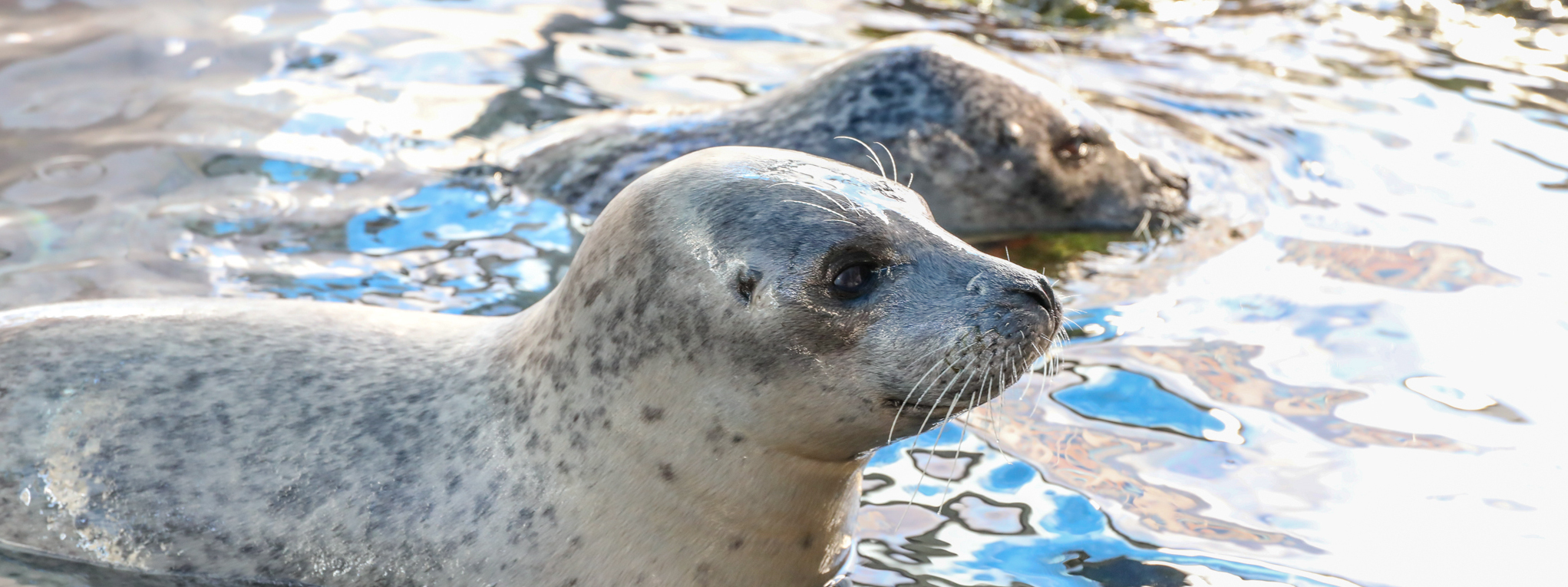
Trumpet, a 37-year-old Atlantic harbor seal, swims up to her trainer Kristy Schute to start her morning husbandry session. The sessions, which happen three to four times a day, are an opportunity for each of the five Atlantic harbor seals at the Aquarium to engage with their trainers, enjoy enrichment activities, and also get a little bit of TLC. Â
The seals—Amelia, Reggae, Trumpet, Chacoda, and Cayenne—are all considered geriatric for their species. The care team keeps an eye out for conditions, such as cataracts and tooth decay, that often affect seals of advanced age. “We look them over from nose to flippers,†said Kristen Van Oss, the curator of Penguins and Pinnipeds here at the Aquarium. Â
Each of the harbor seals has been trained in behaviors that help them participate in their own healthcare, and these husbandry sessions allow Aquarium staff to monitor and upkeep the seals’ well-being. When the trainer holds their hand to Trumpet’s muzzle, Trumpet knows to open her mouth wide for a quick toothbrushing session. Afterward, she is reinforced with some delicious fish.Â
The seals all receive the same high-quality care, and the team is attuned to any of their individual needs. For instance, Reggae, who is 29, needs extra attention paid to his teeth.
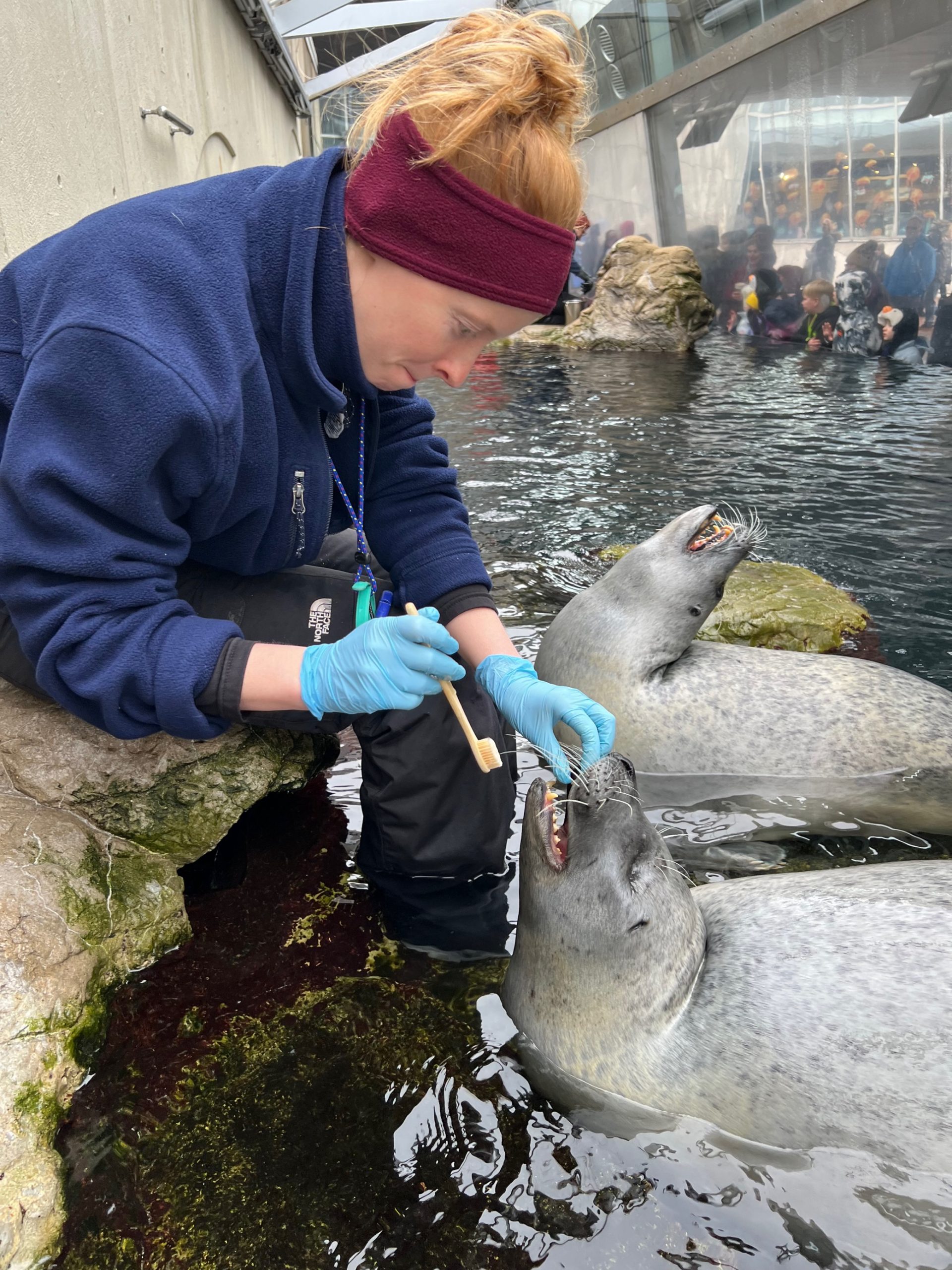
Trainer Kristy brushes both Trumpet and Amelia’s teeth during a morning training session.Â
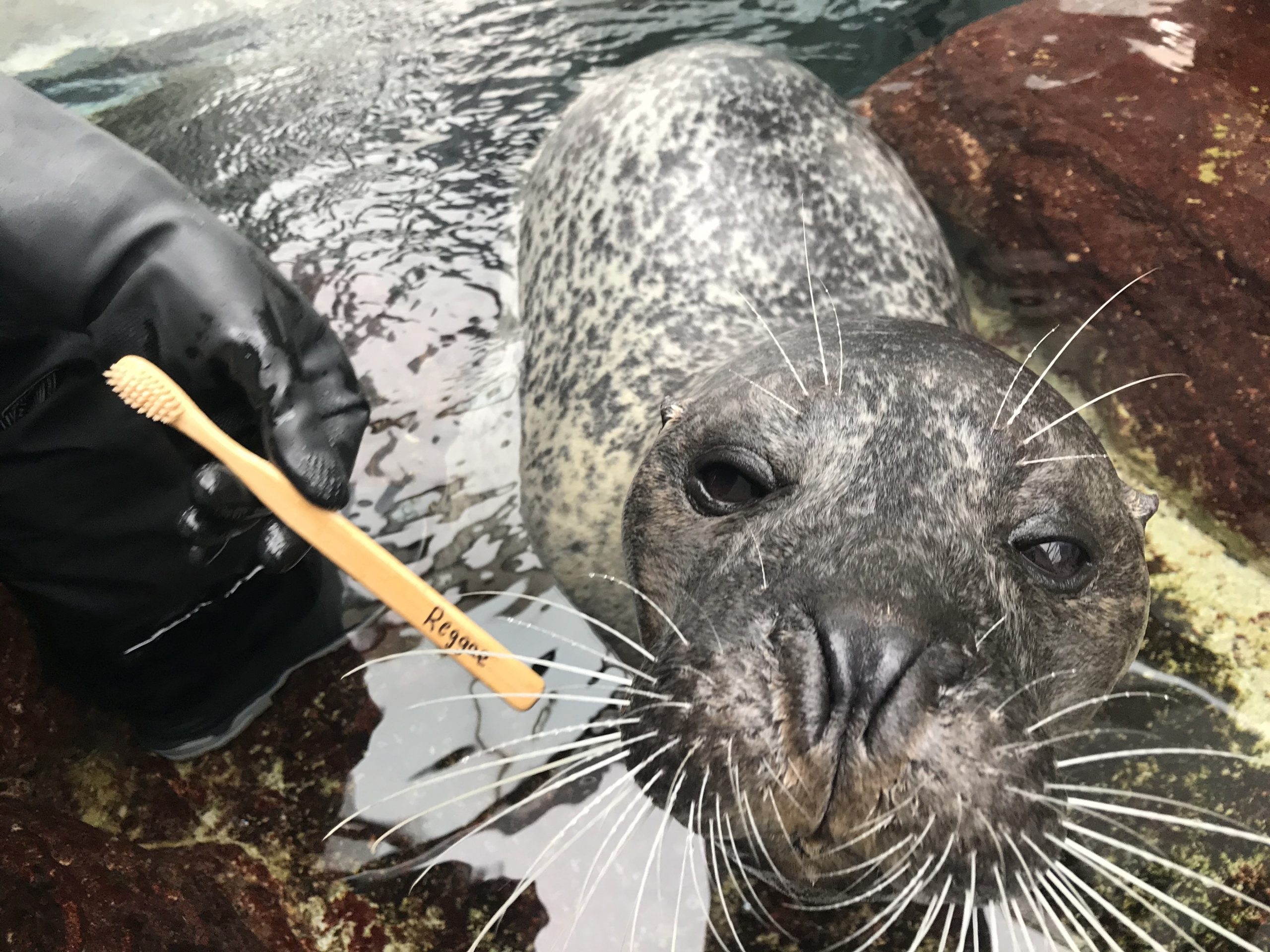
Reggae poses beside his personalized toothbrush.Â
“Over the many years we have worked with Reggae, we have noticed that his teeth build up plaque at a higher rate than the rest of our harbor seals despite the fact that we brush his teeth daily,†said Patty Leonard, the Assistant Curator of the Pinnipeds team. “As with humans, sometimes you might get cavities even though you take great care of your teeth and that’s totally true for our animals, too.†Patty and the team determined that Reggae would need some modifications to his care in order to better protect his teeth and gums. Â
“What we’ve done for him to aid in that care is we trained him to allow us to take x-rays,†Patty said. Reggae will hold a small x-ray plate in his mouth, and the team can bring the x-ray machine—which looks like a hairdryer—close to his face. “With Reggae trained for this behavior, we can take mouth x-rays without having to move him off-site,†Patty said.
It makes the process much easier on both him and the Aquarium staff. Performing x-rays regularly allowed the team to establish a care plan, which involved one intensive dental scaling procedure performed by a vet. Now, the team expects they’ll be able to maintain his oral health throughout the rest of his life with regular cleanings.Â
This kind of specialized care happens in large part due to the trust between the trainer and the animals. “Building that relationship, at whatever the age the animal is, is just so important,†Patty said. “There’s a couple of trainers that work with each of the seals, and they have that trust and camaraderie,†Kristen added. Â
See Reggae’s dental exam behind-the-scenes:
Patty also works closely with Trumpet, who initially was resistant to having minor blood draws—samples the team collects to stay on top of any emergent health issues. “I just learned about her first, and where she was most comfortable, and went from there,†Patty said. “I’m proud to say she’s the only one we don’t need a sample from right now, because we got one a couple months ago!â€Â Â
At the morning training session, Kristy also worked with Amelia, who is perhaps the easiest harbor seal to identify; her left eye was removed after she was experiencing long-term discomfort that was resistant to other treatments. Amelia has been living with one eye for over ten years now, and it hasn’t slowed her down. She uses her extra-sensitive whiskers to help maneuver her surroundings, and she, like Reggae, receives care that’s tailored to her needs—namely, keeping her remaining eye healthy. Â
Though she wasn’t receiving eye drops during that particular session, Amelia demonstrated the behaviors needed to accomplish that goal—keeping an eye open while Kristy mimicked squeezing in the drops. She also received ear drops and showed off a flipper for nail checks. Both Amelia and Trumpet exhibited a few unique behaviors as well—rolling, blowing bubbles, and even leaning in to give their trainers (and visitors) a kiss. Â
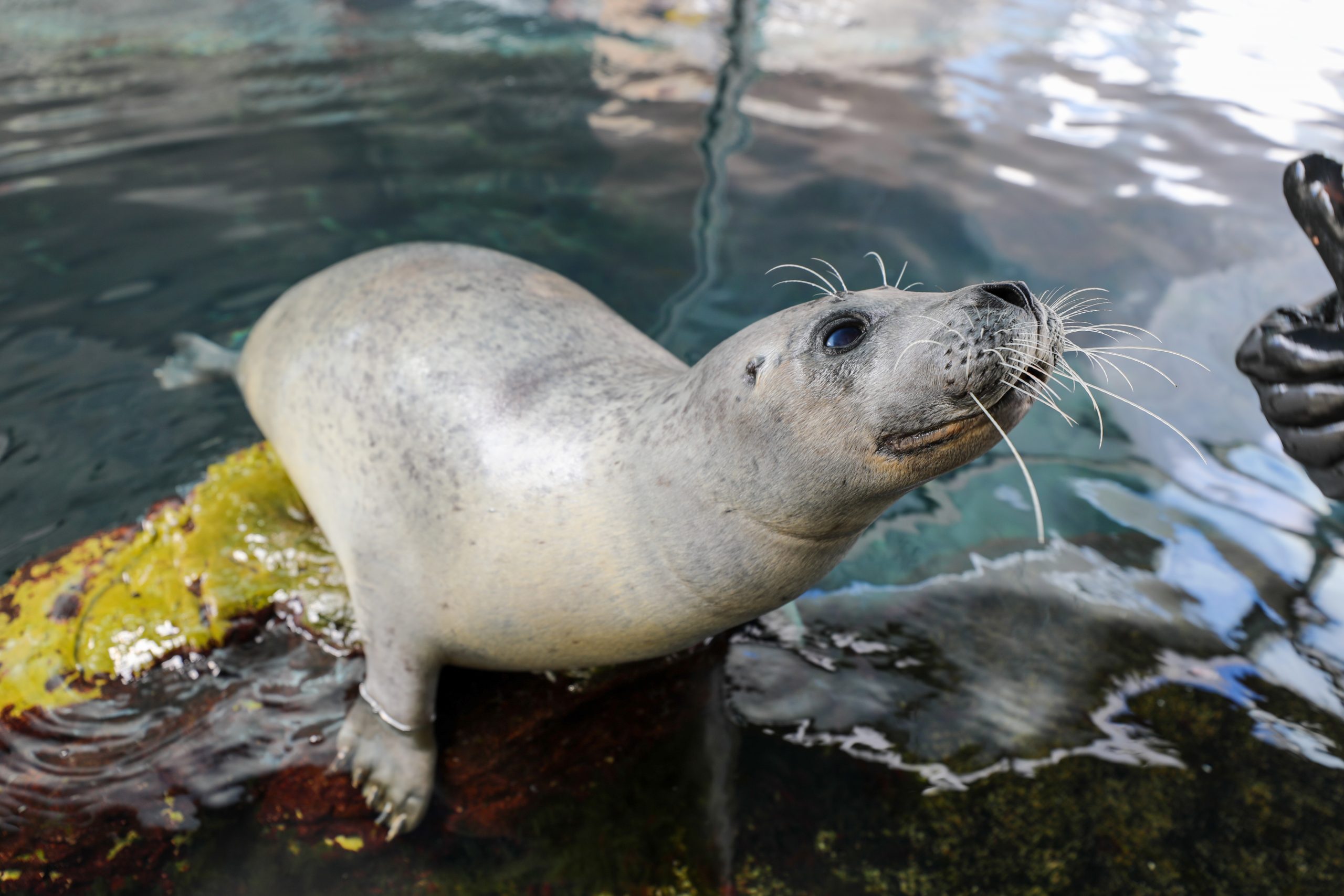
When the session concluded, Kristy showed Trumpet and Amelia the empty bucket and provided a signal letting them know that this was the end of the session until the next check-in. The two splashed back into the water and swam around the exhibit, rejoining the rest of their fellow seals. Because of the strong social bonds the animals have formed over their long lives, there are no current plans to bring more Atlantic harbor seals to the Aquarium.Â
“Our plan is to let these animals continue out their lifespan as-is,†Patty said. “They’re an amazing group of animals together, and we think it’s best to let them live in that social grouping.â€Â Â
As they get older, each of the seals will continue to receive regular checkups, and the team hopes to be able to be proactive as age-related health issues may arise. So far, all of the seals are in good health, even though they’ve all exceeded their expected lifespan. Today, Chacoda—one of Trumpet’s pups—is the youngest, at 27. “Their average lifespan in the wild is 25,†Patty said. “It’s just a huge testament to the care they receive.†Â
